In France, the proportion of people aged over 75 is steadily increasing, along with the demand for services tailored to loss of autonomy. The regulatory framework is evolving: the law of April 8, 2024, has provided for the creation of the Departmental Public Service for Autonomy (SPDA), aimed at centralizing information and guidance for seniors and their caregivers. The deployment of this system varies by region, creating disparities in access to services.
SAD help and SAD help and care: a distinction that families often overlook
Home autonomy services are not all the same. The ongoing reform distinguishes between two categories: SAD “help”, which organize assistance for daily living (cleaning, shopping, meal preparation), and SAD “help and care”, which also coordinate home nursing care.
The difference has direct consequences. A SAD “help” must refer the person to a healthcare professional if a care need arises, but it does not provide that care itself. A SAD “help and care” centralizes both aspects within a single structure, reducing the number of contacts for the family.
Before signing with a provider, it is therefore essential to check their exact accreditation. The presence of a home autonomy service in a municipality does not guarantee that care and daily assistance are combined. For families looking to compare available offers, it is possible to access Astelos Senior services to identify the services suited to each situation.

Housing adaptation for aging: an underestimated challenge
Staying at home relies not only on human assistance. Housing modifications condition daily safety. Grab bars in the bathroom, replacing the bathtub with a walk-in shower, removing door thresholds, enhanced lighting in hallways: these technical changes reduce the risk of falls, the leading cause of hospitalization among seniors.
The French housing stock includes several million homes that would require adaptation work. Financial aid exists (MaPrimeAdapt’, retirement fund assistance), but the administrative procedures can be daunting. A prior evaluation of the home by an occupational therapist or a specialized diagnostician allows for prioritizing interventions based on the person’s level of dependence.
Which renovations to prioritize based on autonomy level
For a person who is still mobile but fragile, the priorities focus on fall prevention:
- Installation of grab bars and handrails in wet areas and staircases, where most domestic accidents occur
- Replacing slippery floor coverings with non-slip materials, particularly in the kitchen and bathroom
- Installing motorized roller shutters and automatic light paths to limit physical effort and movement in the dark
When the loss of autonomy is more advanced, the adaptations include heavier equipment: medical bed, ceiling transfer rail, widening doors for wheelchair access. These renovations fall under a different budget and timeline.
Respite for caregivers: beyond day care
The word “respite” generally evokes day care or temporary accommodation in a facility. These solutions exist, but another option remains unknown: replacing the caregiver directly at the senior’s home.
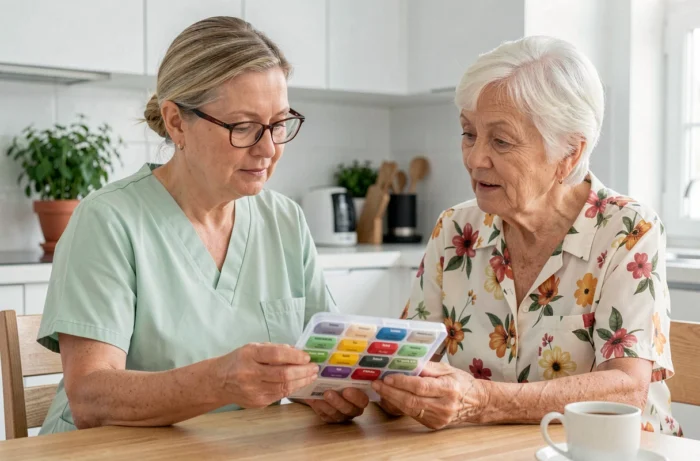
Respite platforms, coordinated by departments and ARS, can direct to temporary home replacement. A professional takes over from the family caregiver for a few hours or days, without the elderly person changing their environment. For seniors with cognitive disorders, avoiding a change of location limits disorientation and anxiety.
How to access a respite platform
The first step is to contact the CLIC (Local Information and Coordination Center) or the future SPDA in your department. These structures direct to the nearest respite platform and help to compile the application. The access time varies by region: some departments have several platforms, while others have only one for the entire area.
Information on respite services remains fragmented, and caregivers often discover these solutions late, after several months of exhaustion. Local caregiver associations play a relay role that institutional channels do not always fulfill.
Meal delivery and social connection: two functions in one
Meal delivery at home serves an obvious nutritional function, but its social role is undervalued. For isolated individuals, the daily visit from the delivery person can sometimes be the only human contact of the day. Some meal delivery services train their staff to spot warning signs: visible weight loss, unusually messy living conditions, confusion in conversations.
The quality of delivered meals varies significantly from one provider to another. Menus adapted to specific diets (low salt, modified textures for swallowing difficulties) are not always offered. Checking the menu composition and delivery frequency before committing helps avoid disappointments that may lead the elderly person to refuse the service after a few weeks.
- The cost of meal delivery may be partially covered by the APA (personalized autonomy allowance) or by retirement funds, depending on the assessed level of dependence
- Some municipalities offer a sliding scale based on income, making the service accessible even with a small pension
- Daily delivery is not the only option: cold chain formulas allow for receiving several meals in a single weekly delivery
The choice between these options depends as much on the person’s ability to reheat a dish as on their need for regular contact. A well-calibrated meal delivery service combines nutrition and social monitoring, two pillars of staying at home that families would benefit from considering together rather than separately.