The renovation budgets of French households are now divided between two priorities that compete for the same funds: energy efficiency improvements in housing and visual comfort of the interior. Insulation of attics, replacement of a boiler, adaptation of a room for remote work – these items absorb an increasing share of expenses even before the question of decoration arises. Interior redesign has not disappeared, but it is changing form.
Decorative redesign and energy constraints: a common arbitration
When replacing a heating system or installing interior insulation consumes the renovation budget, redesign involves lighter interventions. Painting, textiles, lighting, accent walls: these levers allow for transforming the ambiance of a room without engaging in a second construction project.
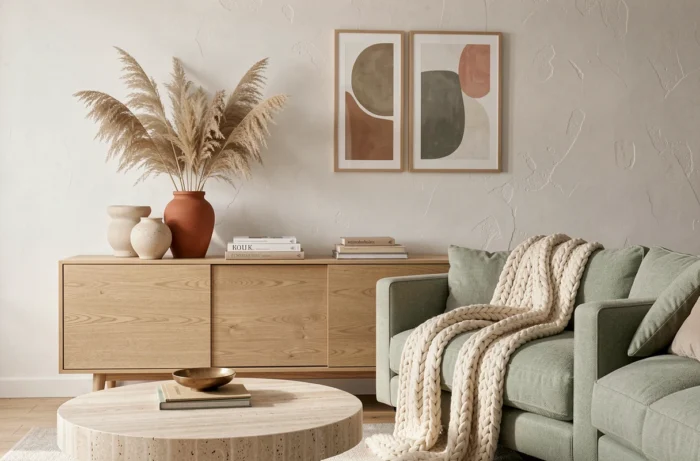
This shift modifies the way decoration trends spread. Deep color palettes (terracotta, muted greens, warm browns) are gaining ground because they can be applied to just one wall. A reupholstered sofa or a sculptural light fixture is enough to give character to a living room whose walls have just been covered with insulating panels.
Field reports diverge on the compatibility between thermal renovation and ambitious decoration. Some craftsmen note that clients postpone all decorative purchases after insulation work, while others integrate a “visual finishes” budget into the overall estimate from the start. Following decor news on Déco en Vogue helps identify solutions that work within a constrained budget.
Modular spaces and adaptation to new uses
Modularity is no longer just a catalog argument. It responds to concrete situations: an office set up in the guest room, a living space that accommodates three generations, a living room that must serve as a video conferencing space during the day.
Professionals design spaces capable of changing use without heavy intervention. Movable partitions, multifunctional furniture, integrated storage that frees up floor space: these choices structure the decoration as much as the wall colors.
What modularity changes in decorative choices
An interior designed to evolve imposes constraints on furniture. The modular sofa replaces the fixed corner sofa. Textiles (curtains, cushions, throws) become the main vectors of personalization because they can be changed without tools.
- Lightweight and repositionable furniture takes precedence over bulky pieces, favoring organic lines and natural materials like light wood or rattan
- Colors are chosen based on their neutral background (walls, floor) to accommodate seasonal textile changes
- Rail or articulated arm lighting replaces fixed pendants, allowing for lighting adjustments to each room configuration
This approach has a secondary effect on style: it promotes clean atmospheres, close to Scandinavian or minimalist styles, not out of taste but out of functional necessity.
Healthy materials and traceable reuse: two requirements reshaping decor
The choice of materials is no longer limited to visual or tactile aspects. Upholstery textiles not treated with PFAS (per- and polyfluoroalkyl substances) are gaining visibility in interior decoration projects, according to observations reported by the PRC Auvergne in October 2026. This health requirement adds a selection filter rarely addressed in classic decor guides.
Meanwhile, the reuse of materials and furniture is no longer just about hunting for an old piece for its charm. The traceability of materials becomes a project criterion: identifying the origin of reclaimed flooring, verifying the composition of second-hand fabric, documenting the potential for reuse of an item before integrating it into a design.
Colors rooted in the territory
Color palettes tend to move away from uniform international references to become more anchored in a local context. Shades inspired by regional landscapes (southern ochres, bluish grays of the Atlantic, forest greens) appear in paint and wall covering collections.
This trend produces more unique interiors than standardized decors, but it remains difficult to quantify. Available data does not allow for precise measurement of the extent of this movement compared to globalized palettes like Pantone.
Decoration trends 2026: what endures and what tires
Not all trends have the same lifespan. Some respond to a structural need (modularity, healthy materials) and establish themselves durably. Others fall under a fashion effect whose limits become apparent with use.
- Maximalism (grandmacore, revisited Memphis style) is appealing in photos but feedback from residents points to quick fatigue with very busy patterns in everyday life
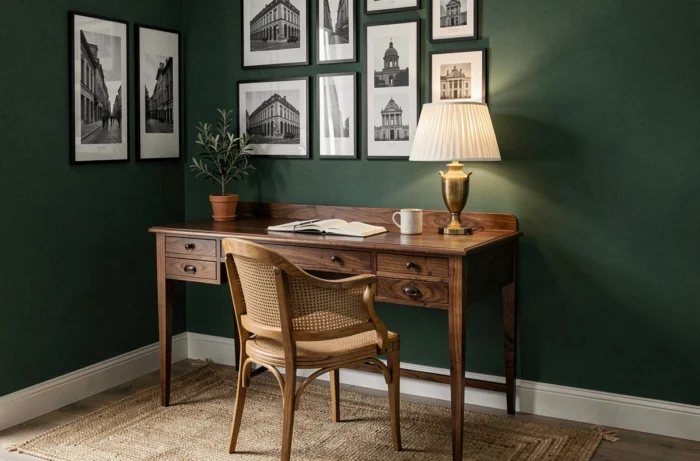
- Dark wood (walnut, smoked oak) maintains its place in high-end projects, driven by the search for warmth and visual depth
- Chrome and shiny metallic finishes return in accessories (handles, furniture legs, lighting) without imposing themselves on large surfaces
- Wall tiles, from floor to ceiling in certain wet areas, divide opinions: appreciated for maintenance, criticized for the coldness they can convey in small spaces
Light interventions (painting, textiles, lighting) remain the most accessible lever for redesign when the bulk of the budget goes towards the thermal envelope of the housing. A well-chosen accent wall, a change of curtains, and a sculptural light fixture can transform a room for a fraction of the cost of a complete redesign.
Interior decoration is no longer thought of as a layer added after the work. It is integrated from the design stage, composing with energy constraints, the actual uses of the rooms, and health requirements for materials that did not exist a few years ago.