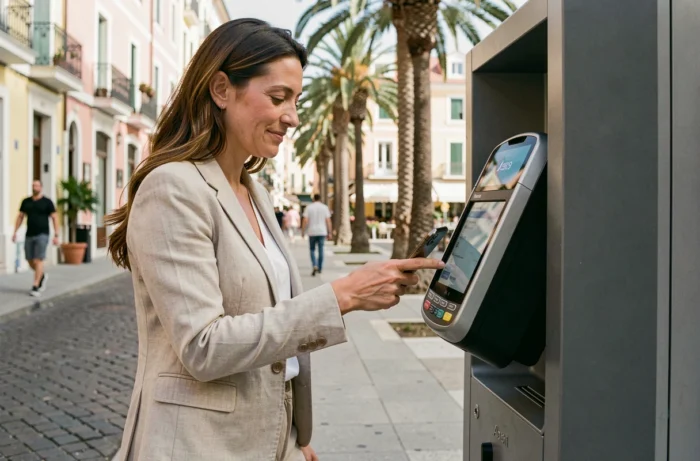
The EMV standard, the technical foundation for chip and contactless transactions, now underpins almost all in-person retail payments. In Nice, its widespread deployment across payment terminals covers restaurants, shops and tourism providers. Things get more complicated outside traditional retail, with urban transport, regional coaches and on-street parking.
EMV contactless protocol: kernels C-2 to C-8 and interoperability limits in Nice
An EMV-certified contactless terminal contains several kernels, each dedicated to a scheme (Visa payWave, Mastercard PayPass, CB contactless, American Express, Discover, UnionPay). Retailers in Nice that accept contactless payments generally enable the Visa, Mastercard and CB kernels. Running these three schemes on the same reader ensures compatibility with most European cards.
The friction arises outside retail. Lignes d’Azur does not accept contactless bank card payments at its validators. Passengers must use a network ticket, loaded onto a rechargeable card or through the dedicated app, and validate it each time they board. Replacing paper tickets with digital or rechargeable passes means visitors need to plan ahead and buy or top up their ticket before boarding a tram or bus.
A closer look at the applications of EMV terminals in Nice reveals the gap between seamless retail payments and fragmented urban public transport systems.
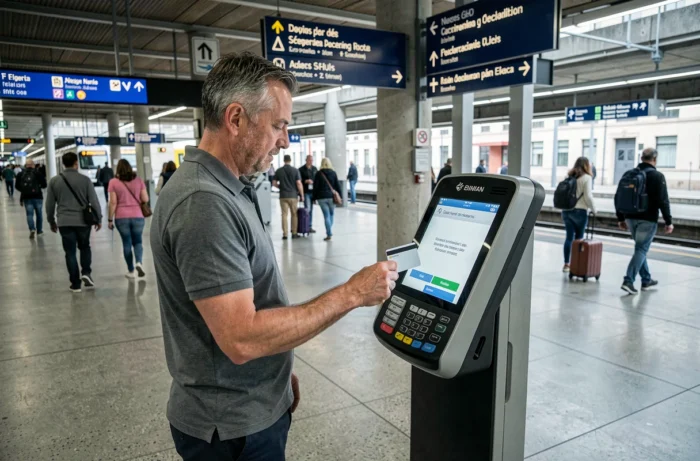
Contactless payments on public transport in Nice: three systems for one journey
A visitor arriving at the airport, taking the tram into the city centre, then catching a regional coach to Monaco encounters three distinct validation systems. This reality challenges the idea of unified payments through contactless technology.
Lignes d’Azur trams and buses
No bank card tap-to-pay. Tickets must be purchased in advance, either from a ticket machine or through the network’s mobile app. The network’s rechargeable card uses NFC, but it is a proprietary system, not a bank card EMV transaction.
ZOU! regional coaches to Monaco and Menton
Contactless bank card payments at the validator are available on ZOU! routes. Passengers can tap their Visa or Mastercard directly on the coach’s terminal. This is the only part of public transport on the French Riviera where the EMV payment loop is complete, from the terminal to the banking network.
On-street parking
Nice’s parking meters accept bank cards, often in contact mode (chip insertion). Some newer models also support contactless payments. Paying through a mobile app requires entering the vehicle’s registration number and the parking zone. Correctly identifying the vehicle and zone is still mandatory, regardless of the payment method.
- Lignes d’Azur (trams, buses): proprietary ticket required; no bank card EMV payments at validators
- ZOU! coaches (regional routes): contactless bank card payments accepted directly at the validator
- Parking meters: bank card by chip insertion or contactless, depending on the model, or an app requiring the registration number and zone
EMV terminals in Nice shops: what the protocol means for cardholders
In Nice’s shops, EMV contactless transactions follow a standardised process. The terminal sends a SELECT command to the payment method, negotiates the appropriate kernel, then applies the risk management rules set by the issuer and scheme.
For amounts below the contactless limit (set by the card issuer), the transaction goes through without a PIN. Above that limit, the terminal automatically switches to contact mode and requests PIN verification. The switch between contact and contactless is managed by the terminal, not the retailer.
Recent Android terminals deployed at several retailers in Nice also accept mobile wallets (Apple Pay, Google Pay, Samsung Pay). These wallets emulate an EMV card using a token, maintaining the same level of cryptographic security as a physical chip card.
What to expect with foreign cards
Visitors from outside the eurozone may sometimes find that their contactless payment is declined if their card is not compatible with the CB kernel. Well-configured terminals then try the Visa or Mastercard kernel instead. Retailers in tourist areas (Vieux-Nice, Promenade des Anglais) generally have multi-kernel terminals, which helps reduce payment issues.
EMV contactless security in Nice: tokenisation and offline risk management
The EMV contactless protocol uses a dynamic cryptogram generated for every transaction. Unlike magnetic stripe data, information captured during an NFC exchange cannot be used to replay the transaction. This mechanism protects cardholders even if the radio signal is intercepted.
Each transaction generates a unique cryptogram that cannot be replayed. Schemes also enforce offline counters: after a certain number of consecutive transactions without a connection to the banking network, the terminal requires an online authorisation. The threshold varies by issuer and the country where the card was issued.
- Dynamic ARQC/TC cryptogram: prevents transaction data from being reused
- Cumulative offline counters: require an online check after a set number of transactions
- Wallet tokenisation: the actual card number is never sent to the terminal during a mobile payment
For visitors to Nice, these mechanisms make contactless payments in shops as secure as transactions that require a PIN. The remaining risk is more likely to come from a lost or stolen card than from a flaw in the protocol.
The promise of frictionless payments in Nice holds true in shops, where EMV terminals work seamlessly across schemes. But once you board a tram or park your car, you have to juggle a proprietary ticket, a dedicated app and a parking meter. We find that the move towards universal bank card payments on Nice’s urban transport network remains a work in progress, while regional routes have already made the switch.